
A special and rarely captured series of events in the night sky
Enjoy photography, real-time, slow-motion Red Sprite lightning captures with an expert scientist breakdown. Here we try to shine some light on these most beautiful and mysterious phenomena.
NOT FOR REBROADCAST
COPYRIGHT PAUL SMITH 2025
To license video contact smith.paul.michael1@gmail.com
Rare high-speed Red Sprite and other Transient Luminous Event captures with an emphasis on the science behind them.
Support this channel and further citizen science:
https://www.buymeacoffee.com/paulmsmithphoto
Music via Artlist.
Special thanks to Pecos Hank for the lightning clip and to Dr Yoav Yair and Dr Oscar Van Der Velde for the use of their scientific footage and expert input.
Video:
Paul M Smith Photography

7:31

Dive into the awe-inspiring world of the colossal jellyfish! Discover their bioluminescence and survival secrets! #OceanLife #Jellyfish #Bioluminescence #MarineBiology #NatureWonder
Video:
The Enchanted Expeditions
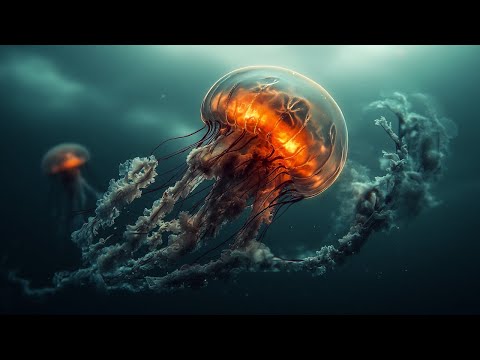
The SCARIEST CRYPTID You Never Heard Of
00:00 - 00:48 | Intro
00:49 - 02:41 | Christopher Lobe's Encounter
02:42 - 03:08 | Hydropraphic Team's Confirmation
03:09 - 04:56 | Richard Winter's Encounter
04:57 - 06:20 | Henry Bell's Story
06:21 - 08:00 | Henry Asor's Encounter
08:01 - 08:48 | Gulf of Mexico
08:49 - 11:49 | SS Kuranda Sighting
When it comes to the scariest cryptids, a few might pop into your head. Maybe you’ve heard of aggressive Sasquatches attacking people, like in the famous Ape Canyon story, or perhaps you know about divers and swimmers being attacked by the Lusca, a giant octopus said to live in the Bahamas. But for me, the scariest cryptid of all is the giant jellyfish.
#cryptids #Cryptidstories #Giantjellyfish #USA
Video:
Obscura Realms

“Unbelievable! Huge Jellyfish & Bahrain Culture 😱 | Night Ocean + Museum Scenes
Unbelievable! Huge jellyfish spotted in the waters of Bahrain 😱
Is video mein aap dekhenge ek rare night scene jahan giant jellyfish paani ke fountain ke paas dikh rahi hai. Saath hi, aapko Bahrain ki culture aur museum scenes bhi dekhne ko milenge — jahan purane zamane ka lifestyle (handpump, chulha, bhatti, etc.) showcase kiya gaya hai.
Yeh 13+ minutes ka full video hai jo ocean life + culture ka unique combination dikhata hai.
📍 Location: Arabian Gulf
🎥 Full 13+ minute footage
⚠️ Stay safe & don’t touch jellyfish
👉 Like 👍 Share 🔁 Subscribe 🔔 for more amazing videos!
#RumiFamilyVlogs
#Jellyfish #Bahrain #MarineLife #OceanLife #GiantJellyfish #SeaCreatures #Underwater #Nature #ViralVideo #Trending #ArabianGulf #OceanWorld #NightOcean #Museum #Culture
rumifamilyvlogs
jellyfish
bahrain jellyfish
giant jellyfish
huge jellyfish
jellyfish night video
jellyfish arabian gulf
marine life video
ocean creatures
underwater footage
jellyfish fountain scene
viral jellyfish
sea animals video
nature documentary
bahrain culture
museum video
old lifestyle museum
trending video
13 minute video
Video:
Rumi Family Vlogs

You’re in the middle of the ocean at night… and suddenly, a glowing, nearly invisible creature drifts past you—long, trailing tentacles extending like ghostly threads into the darkness. This is what many call the “phantom jellyfish.”
The term usually refers to a deep-sea species known as Stygiomedusa gigantea, one of the largest and most elusive jellyfish ever observed. Despite being discovered over a century ago, scientists have recorded only a limited number of sightings. Most of what we know comes from deep-sea submersibles and remotely operated vehicles exploring depths below 1,000 meters.
Unlike typical jellyfish, this species lacks the stinging tentacles used for capturing prey. Instead, it has four long, ribbon-like oral arms that can extend over 10 meters. These structures function more like drifting nets, passively trapping small organisms such as plankton and fish larvae. This feeding strategy is an example of energy efficiency in extreme environments, where food is scarce and conservation of energy is critical for survival.
The deep sea itself is a high-pressure, low-temperature biome with almost no sunlight. In these conditions, many organisms evolve transparency or bioluminescence. The phantom jellyfish appears almost invisible because its gelatinous body is composed of over 95% water, minimizing light reflection. This is a form of camouflage known as “optical invisibility,” reducing detection by predators.
From a physiological perspective, its simple body plan is highly effective. Jellyfish lack a centralized brain and instead rely on a decentralized nerve net. This allows them to respond to environmental stimuli without expending the metabolic energy required for complex neural processing—an advantage in nutrient-poor ecosystems.
If you’re interested in deep-sea mysteries like this, subscribe now, because the ocean still hides more unknown life than we’ve ever discovered.
Another intriguing aspect is its role in the marine ecosystem. Even though sightings are rare, organisms like this contribute to carbon cycling. When deep-sea jellyfish die, their bodies sink, transporting carbon from the surface to the ocean floor—a process known as the “biological pump,” which plays a measurable role in regulating Earth’s climate.
So the “phantom jellyfish” isn’t just a strange creature—it’s a reminder of how much of our planet remains unexplored, operating under biological rules very different from those on land.
#oceandeep #ocean #jellyfish #biology #giganteamedusa #phantomjellyfish
Video:
Natural Talent

What if you were just taking a walk on the beach and discovered a massive, never-before-seen creature? That's exactly what happened in Tasmania, revealing how much we still don't know about our own planet's oceans. In 2007, retired biology teacher Dr. Lisa-ann Gershwin was beachcombing after a storm when she found an enormous, gelatinous blob washed ashore. It was unlike anything she had ever seen, far exceeding the size of any recorded jellyfish. Her careful observation and reporting led to a groundbreaking scientific discovery. This video explores the incredible moment of finding this new species, now known as the Tasmanian Lion's Mane Jellyfish. We'll dive into what makes this creature so unique, how it remained hidden for so long, and the scientific impact of its discovery. This astonishing find proves that even in the 21st century, vast, unknown life forms exist in our oceans, and ordinary people can contribute significantly to scientific knowledge. It's a powerful reminder of Earth's unexplored mysteries and the importance of citizen science. If you're amazed by deep-sea wonders, new species, and unbelievable discoveries that expand our understanding of life, then this story is for you.
Video:
NextGen

During these first ever ROV dives in Revillagigedo Archipelago, the Nautilus team has encountered some truly otherworldly organisms. This Deepstaria jelly awed us with its shapeshifting abilities as its bag-like bell inflated and undulated with current created by movement of ROV Hercules. Capturing prey in its voluminous bell, a strikingly geometric network of canals delivers nutrients throughout this large jelly’s body.
This close encounter was captured with both our normal ROV Hercules HD camera and a low light camera for bioluminescence designed by Dr. Brennan Phillips at University of Rhode Island's Graduate School of Oceanography and David Gruber at the City College of New York/Baruch College.
------------------------------------------------
E/V Nautilus is exploring unknown regions of the ocean seeking out new discoveries in biology, geology, and archaeology. Join us 24/7 for live video from the seafloor and to ask questions of our explorers currently aboard Nautilus: www.nautiluslive.org.
Follow us on social media for dive updates, expedition highlights, and more:
Subscribe on YouTube: www.youtube.com/subscription_center?add_user=EVNautilus
Facebook: www.facebook.com/nautiluslive
Twitter: www.twitter.com/evnautilus
Instagram: www.instagram.com/nautiluslive
Video:
EVNautilus